
How to Check Criminal History in Shelby County
A Shelby County criminal history check works best as a sequence, not one name query. Begin with the Shelby County event you need to verify. The official inmate listing covers current inmates, recent arrivals, and releases during the last thirty days. The Shelby County Sheriff’s monthly intake and release archive reaches farther back. A police or Sheriff report supplies the incident narrative. The Circuit Clerk then shows filed charges and their disposition, while ALEA Criminal Justice Information Services holds the fingerprint-supported Alabama history.
Have the full legal name, spelling variants, an approximate event date, arresting agency, and any booking or case number ready. A common name alone is weak proof. Keep the incident number, jail number, and court case number separate because one system may not accept another system’s identifier.
- Search current or recent Shelby County jail custody, then check the monthly intake and release reports if the live view has expired.
- Ask the Sheriff or the city police department that handled the event for its incident or arrest report.
- Search the correct Circuit, District, or municipal court for filed counts, hearings, disposition, and sentence.
- Use ADOC or BOP only after a transfer to state or federal custody, and use the proper registry for registry information.
- For your own consolidated Alabama history, submit ALEA’s fingerprint-based CHRI review packet and obtain certified source records if a correction is needed.
These channels serve distinct purposes:
| Official channel | Best for | Access route |
|---|---|---|
| Shelby County Jail | Current, recent, and short-term release custody | Free web roster, monthly archive, or jail line |
| Arresting agency | Incident facts and arrest narrative | Agency records desk, phone, counter, or written request |
| Circuit Clerk | Filed charges, docket, disposition, and sentence | Room 1F counter, phone, written copy request, or AlacourtACCESS |
| ALEA CJIS | Your fingerprint-supported statewide Alabama CHRI | Fingerprint application by mail or in person |
Shelby County Criminal Record Portals
The Shelby County Transparency hub is the best public index to local tools. It links the Shelby County dispatch log, jail listing, most-wanted records, calls and crime information, sex-offender resources, and the formal records-request route. Those links do not form one criminal history database. Shelby County dispatch activity reflects calls, the jail reflects custody, and a wanted entry reflects public warrant information. A court result still comes from the clerk.
The county’s official Transparency source shows how those criminal record channels are grouped.
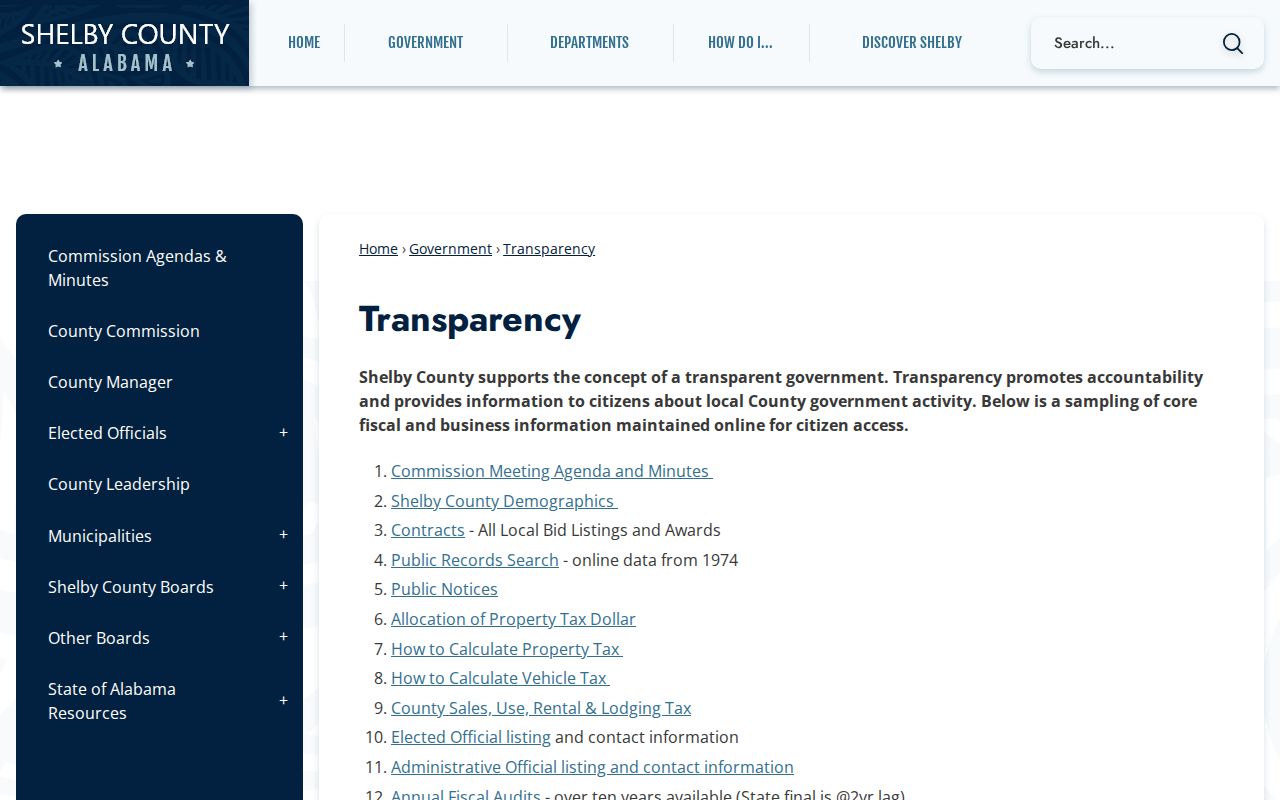
That layout is useful as a starting map, but each linked system must be read within its own scope and date window.
The inmate portal itself offers a narrow set of controls:
| Control | Type | What it does |
|---|---|---|
| A-Z alphabet | Links | Filters Shelby County jail records by last-name initial |
| Last Name Search | Text | Runs a last-name query without a published wildcard rule |
| Custody view | Tab or radio choice | Switches among Current Inmates, Recent Arrivals, and Release in the Last Thirty Days |
Note: A dispatch call, jail booking, or warrant entry does not by itself establish a Shelby County criminal conviction.
Official Alabama Background Checks
Alabama does not provide a general-public name search of the state repository. The Alabama Background Check System is restricted to qualifying subscribers with legal authority. A Shelby County resident who wants to review their own record instead uses the ALEA Application to Review Alabama Criminal History Record Information. The packet needs a completed application, an FBI-approved fingerprint card, current photo identification, and a $25 cashier’s check or money order. An extra copy costs $5.
The ALEA source shows the official self-review route for Alabama criminal history.
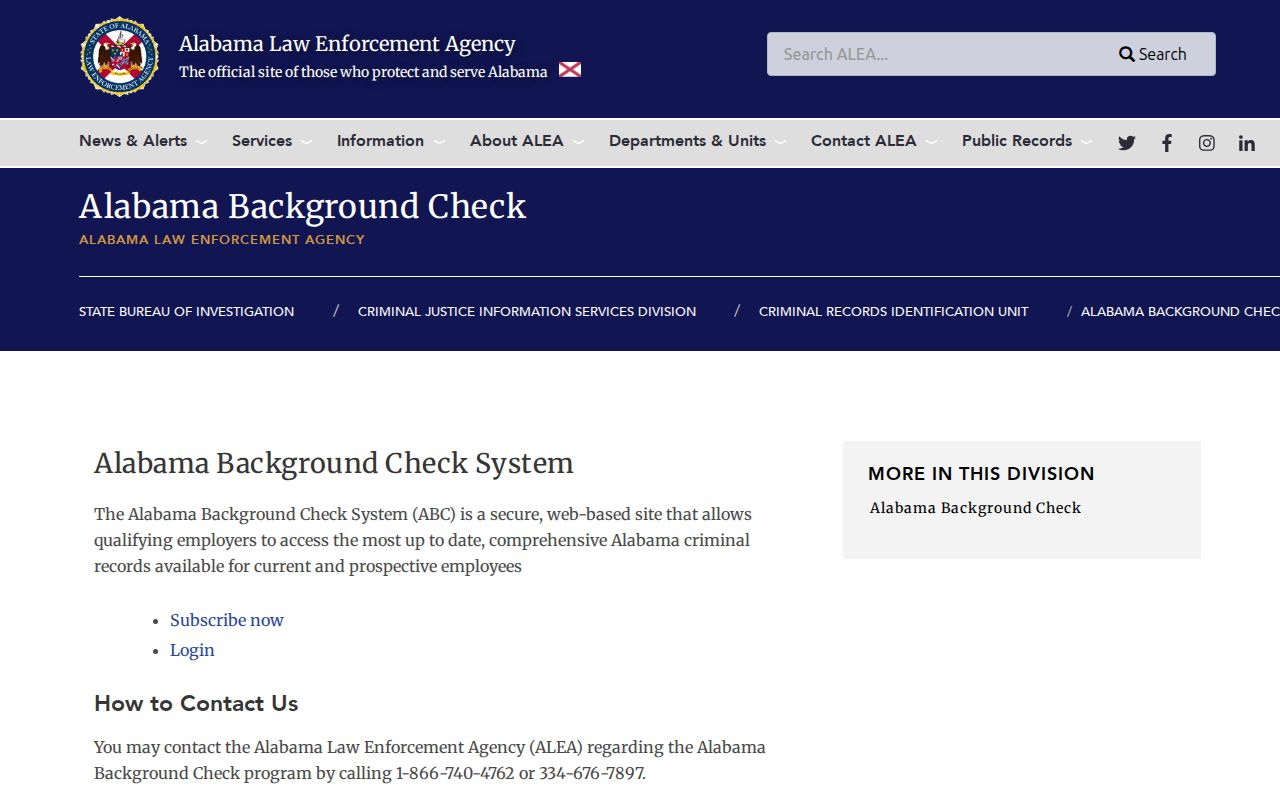
This fingerprint process reaches the state identification file and reported dispositions, unlike a county jail or court-only search.
The packet may be delivered to 301 South Ripley Street in Montgomery or mailed to P.O. Box 1511, Montgomery, AL 36102-1511. ALEA advises allowing at least four to five weeks after receipt. Shelby County residents may book free, appointment-only fingerprinting at the Sheriff’s Main Office at 380 McDow Road. Walk-ins are not accepted. Confirm which fingerprint card and identification to bring before the visit.
Shelby County Warrant Record Checks
The Shelby County most-wanted search uses alphabet links and a last-name field, and it states that data refreshes every 24 hours. It is not a full warrant clearance system. Shelby County says an arrest warrant is not public until served. A person checking a possible warrant for themselves must appear at the Sheriff’s Warrants Division rather than rely on a blank screen.
Shelby County misdemeanor complaints outside a city start with a Sheriff report and District Attorney screening. Events inside a Shelby County municipality route through that police department and municipal court. Bench or alias writs can also stay with a city court. Call the jail and warrant information line at 205-669-4181, check the court that may have issued the process, and resolve the matter only through the Sheriff or court.
The Sheriff’s official public-service homepage documents the correct agency route for warrant, records, and corrections questions.
The Sheriff route also connects readers to records and corrections. The official Shelby County Sheriff AL mobile app offers inmate and registry links, tips, incident and road alerts, safety information, and press releases. It is not monitored for emergencies.
Types of Criminal Records
Shelby County criminal records are created at different points. A police or Shelby County Sheriff report describes the reported event and investigation. A Shelby County jail booking documents intake, holds, bond, and release. The court file records what prosecutors filed and what the judge decided. ALEA CHRI joins fingerprint-supported arrest cycles with dispositions reported to the state. The custody record changes again if a person enters ADOC or federal prison.
- Incident and arrest reports: held by the Sheriff, city police, ALEA Highway Patrol, or another agency that handled the event.
- Booking and release records: held by Shelby County Jail or Hoover City Jail when that facility books the person.
- Criminal court case files: held by Circuit, District, or the municipal court with jurisdiction over the filed case.
- Warrant records: issued by a judge or magistrate and tracked by law enforcement, with unserved warrants kept from public view.
- State history and supervision records: held by ALEA, ADOC, and the Alabama Bureau of Pardons and Paroles within their separate roles.
Federal cases add another layer. Shelby County lies in the Northern District of Alabama. PACER supplies federal dockets, the FBI provides a fingerprint-based Identity History Summary for the subject, and the Bureau of Prisons locator covers federal custody. Local custody detail continues in the Shelby County arrest history, while registry fields and lawful-use rules belong in the Shelby County sex offender check.
Shelby County Booking Record Gaps
The live Shelby County jail listing has three useful windows: Current Inmates, Recent Arrivals, and releases during the last thirty days. It can show inmate number, booking date, charge text, bond type and amount, total bond, and a detail view. Once a Shelby County release moves beyond that window, the Sheriff’s monthly intake and release reports become the official bridge. Those reports add book ID, exact intake and release times, a release code, coded descriptors, and charge entries.
The archive preserves a monthly custody snapshot, not a finding of guilt. For a case outcome, move from the booking identifier to the clerk’s docket. If the person transferred to state prison, use ADOC Inmate Search, which accepts an AIS number or name and covers current ADOC custody.
The ADOC source displays the statewide prison-search entry point used after a Shelby County criminal case results in state custody.
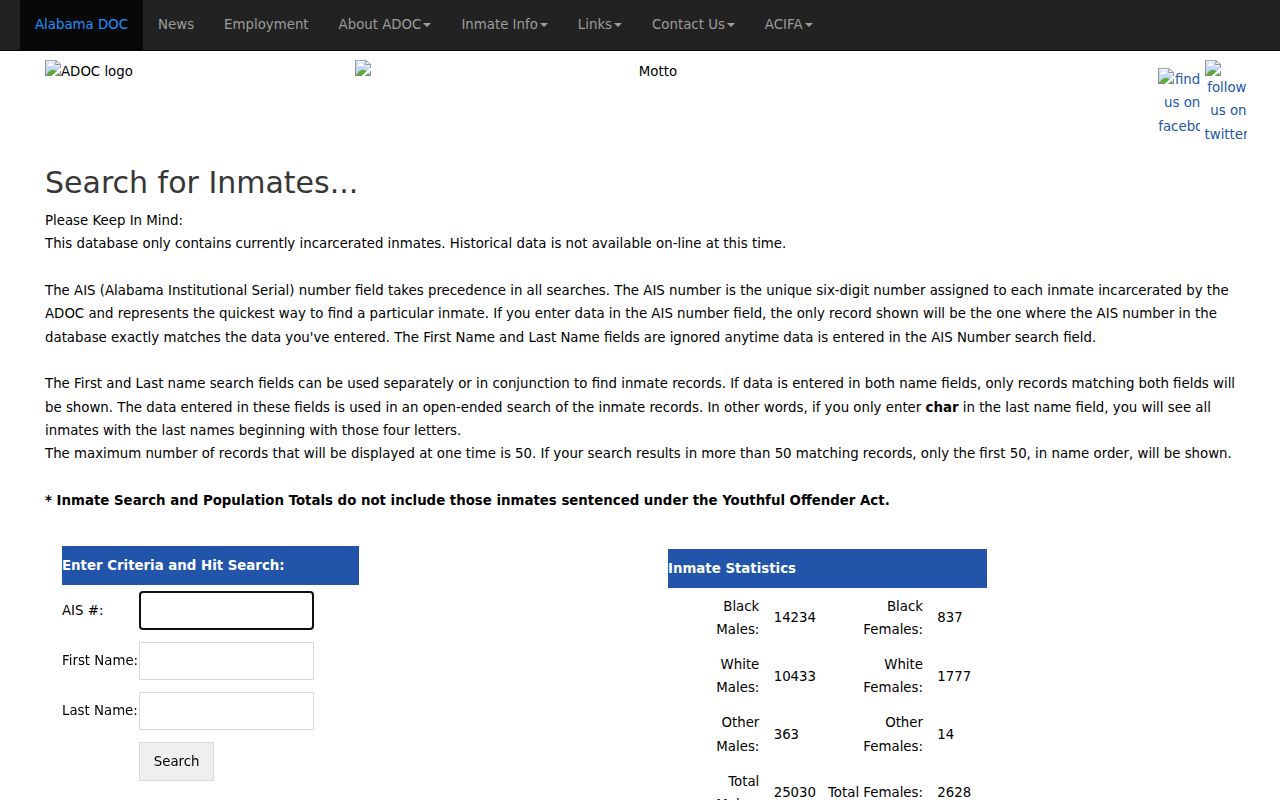
A missing county booking can also mean city custody, a release outside the live window, federal custody, or a record that must be requested from the arresting agency.
What a Shelby County Criminal Record Shows
Shelby County criminal record contents depend on the source. A Shelby County jail record centers on custody. A Shelby County court file centers on counts and disposition. ALEA CHRI connects identifiers, arrest cycles, and reported court results. Sensitive identifiers, juvenile and youthful-offender matters, protected victim facts, and sealed or expunged records may be removed or redacted.
| Name & Identifiers | Legal name, aliases, birth data, demographic descriptors, and agency identifiers where law permits |
|---|---|
| Arrest / Booking Data | Agency, date, book or inmate number, intake and release time, charge received, hold, and bond |
| Charges & Statutes | Filed count, offense description, Alabama statute, classification, and amendments shown in the case file |
| Disposition | Dismissal, nolle prosequi, acquittal, conviction, or another count-level outcome with its date |
| Sentence | Confinement, probation, fines, costs, restitution, and other terms entered by the court |
| Custody / Supervision Status | County jail or ADOC custody and public court proof of a probation sentence; operational ABPP files remain limited |
Three terms prevent common errors:
- Disposition
- The final or current court outcome for a specific count.
- Nolle prosequi
- A prosecutor’s decision not to continue that charge.
- Alias writ
- Reissued court process after an earlier order was not carried out, often tied to a missed appearance.
- Expungement
- The Chapter 15-27 process that removes eligible records from ordinary public access by court order.
Shelby County Criminal Record Flow
A local Shelby County criminal record changes as it moves. The arresting agency writes the incident or arrest report. At booking, Shelby County Jail creates its own number, image, fingerprint, charge, hold, and bond entries. Fingerprint-supported Shelby County arrest data goes to ALEA CJIS. Prosecutors decide which charges to present. Circuit, District, or municipal court then creates the case file, and the clerk reports disposition data back into the state system.
Record flow: Agency report › jail booking › prosecutor review › court filing › disposition › ALEA update.
That flow explains why the arrest charge can differ from the filed count or final judgment. It also explains gaps. Filing lag, unmatched identifiers, a city-only matter, an unreported outcome, confidentiality, or expungement may leave one source blank while another has a record. A careful self-audit compares the agency report, jail entry, each court count, and ALEA response.
Note: The District Attorney screens and prosecutes cases, but police reports and certified court files remain with their original custodians.
Public Access Laws
Alabama residents may inspect and copy public writings unless a specific exception applies. Shelby County criminal records still follow custodian rules. Shelby County Commission records use the county portal. Sheriff records go to the Sheriff. Shelby County case files go to the clerk, and city police reports stay with the city agency. A request should name existing records, dates, and identifiers rather than ask an office to create a report or conduct open-ended research.
Key Laws and Rules:
Alabama Code §36-12-40 gives Alabama residents a right to inspect and copy public writings unless an exception controls.
Rule 33, Alabama Rules of Judicial Administration preserves physical clerk-file inspection even when electronic court access is paid.
Rules 5.1 and 301 govern identifier redaction and the findings required before a court record is sealed.
Alabama Code Chapter 15-27 controls eligibility, filing, effect, and fees for expungement.
Repository CHRI is more restricted than an ordinary public court file. Juvenile data, youthful-offender matters, active-investigation facts, protected victim details, unserved warrants, and security information can be withheld. Lawful redaction is not proof that the rest of the record does not exist.
Shelby County Criminal Records Requests
The Shelby County Open Records process sets a normal response goal of 14 working days for County Commission records. Requests may be made online, mailed, or delivered to Room 123 at 200 West College Street in Columbiana. The county may produce the record, redirect the request, cite an exemption, provide a redacted record, report that no record exists, or explain why more time is required. A deposit may apply when estimated cost exceeds $25.
The county’s official Open Records source lays out those request rules and cost controls.
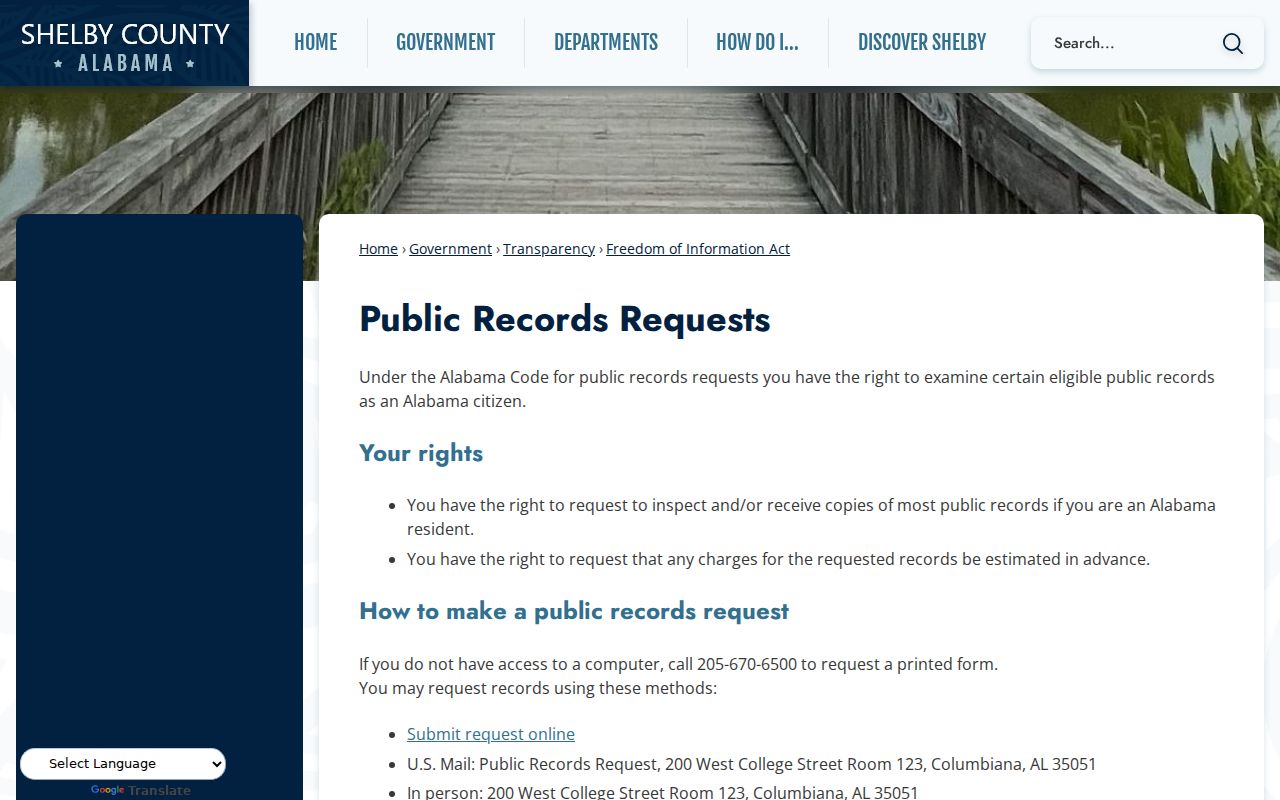
Its scope matters because Sheriff, Circuit Clerk, Probate, and Tax records are controlled by separate elected offices.
The official online request portal asks for the source department, a detailed record description, Alabama residency, contact and address data, identity-document responses, organization, and signature.
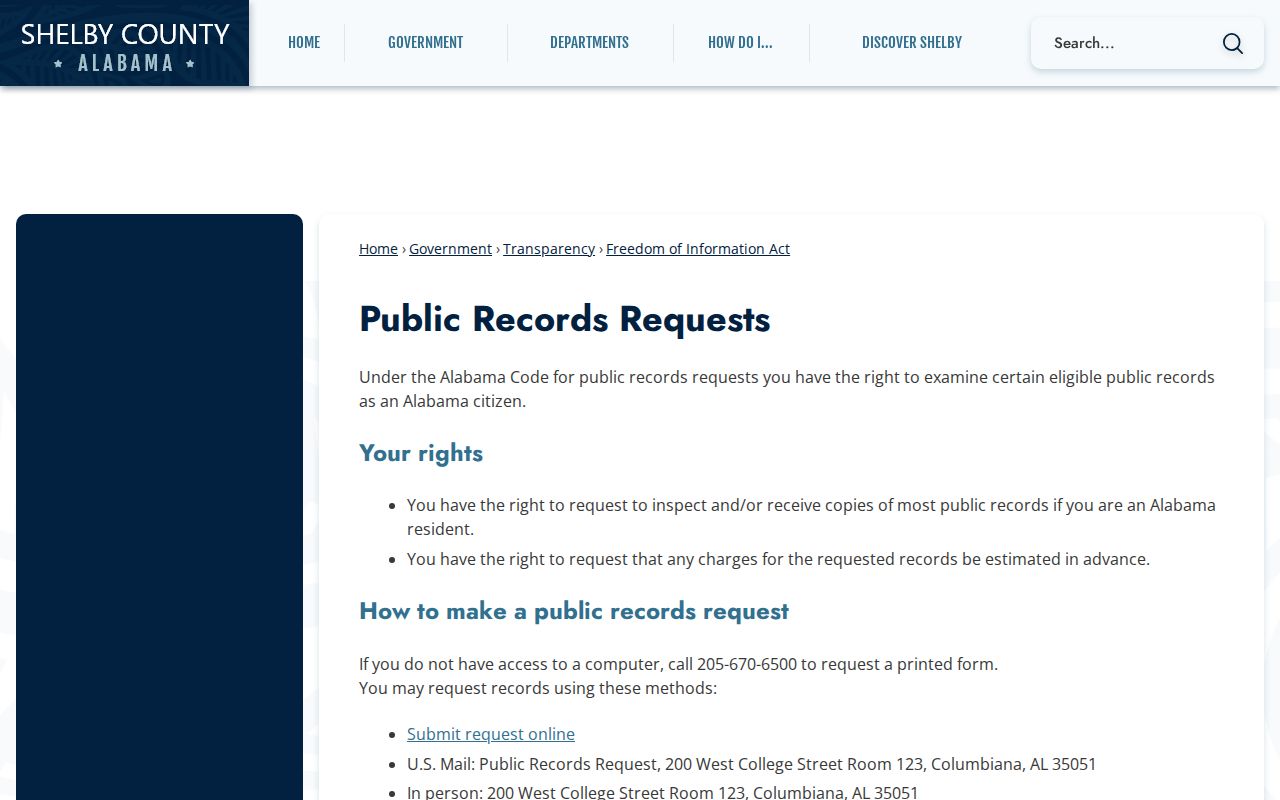
Submitting the form is free, but production may cost $0.50 per page, $5 per DVD, plus labor after the first 15 minutes under the published schedule.
Sheriff-created reports instead start at 380 McDow Road or 205-669-4181. Court inspection and copies start with the Circuit Clerk at 112 North Main Street, Room 1F, 205-669-3760. City reports go to the city records unit.
Sealed, Expunged & Restricted
Expungement and sealing are not the same in Alabama. Rule 301 sealing requires a hearing and written findings. Expungement under Chapter 15-27 removes eligible records from ordinary public access through a separate court process. A dismissal alone does not guarantee that an arrest has vanished from the agency, jail archive, court, or ALEA history.
Shelby County requires the statewide CR-65 petition on paper. One offense goes on each petition under the current instructions. The filing packet needs the certified ALEA criminal record and a certified arrest record, disposition, or case-action summary from the proper agency. The Circuit Clerk charges $10 per charge or count for supporting District or Circuit records. The statutory administrative fee is $500 in addition to ordinary costs, while the current form permits an indigency waiver if the court finds indigency. Confirm the live rule with the clerk because older local wording conflicts with the current form.
Every Shelby County arresting, booking, detention, court, and record-holding entity must be identified and served, along with the District Attorney. After an order, verify the result through a new ALEA self-review and the Shelby County clerk. Juvenile and youthful-offender records, protected identifiers, active investigative material, and unserved warrants remain restricted under separate rules.
Shelby County Supervision Records
Adult felony probation and parole are run by the Alabama Bureau of Pardons and Paroles, not a county probationer-name database. The public court docket is usually the clearest proof that probation was imposed. ADOC may show custody or release from prison, while ABPP field offices release only what law permits from operational supervision files.
The ABPP source lists the field-office channel for local supervision questions.
Shelby County is served by the Calera Field Office and Day Reporting Center Lite at 15863 Highway 25, Calera, 205-669-4611, weekdays from 8:00 a.m. to 5:00 p.m.
A public verification chain starts with the sentencing order, then checks ADOC for prison custody or release and contacts ABPP for releasable supervision facts. A technical violation can produce a report, motion, warrant, hearing, and later order. The public status comes from the court action, not a claim about a missed appointment. Juvenile probation records remain confidential.
Criminal Records by City in Shelby County
City location changes a Shelby County criminal record search. Municipal police keep their own incident reports, and municipal courts can retain ordinance, traffic, and misdemeanor files. Hoover also crosses the Shelby and Jefferson county line, so the event address controls county venue. The three city guides below match the official 2025 Census ranking and route readers to the correct police, jail, city court, and county channels.
Hoover Criminal History
93,550 residents · Confirm the county, then check Hoover Police, City Jail, Municipal Court, and the correct county clerk.
Alabaster Criminal History
34,748 residents · Police reports, municipal files, county bookings, and felony filings follow separate official routes.
Pelham Criminal History
25,664 residents · Police and court share one building but keep distinct report and case records.
Each Shelby County city path eventually connects to county or state records only when custody, venue, or repository reporting makes that next step proper.
Shelby County Federal Criminal Records
A Shelby County court search does not cover federal prosecution. The U.S. District Court for the Northern District of Alabama has federal jurisdiction here. PACER supplies federal dockets and documents after registration, courthouse terminals may offer another access route, and the Bureau of Prisons locator covers federal custody. Federal warrants may remain sealed and will not be replaced by the county most-wanted list.
For your own federal fingerprint history, the FBI Electronic Departmental Order portal accepts an Identity History Summary request under FBI rules.
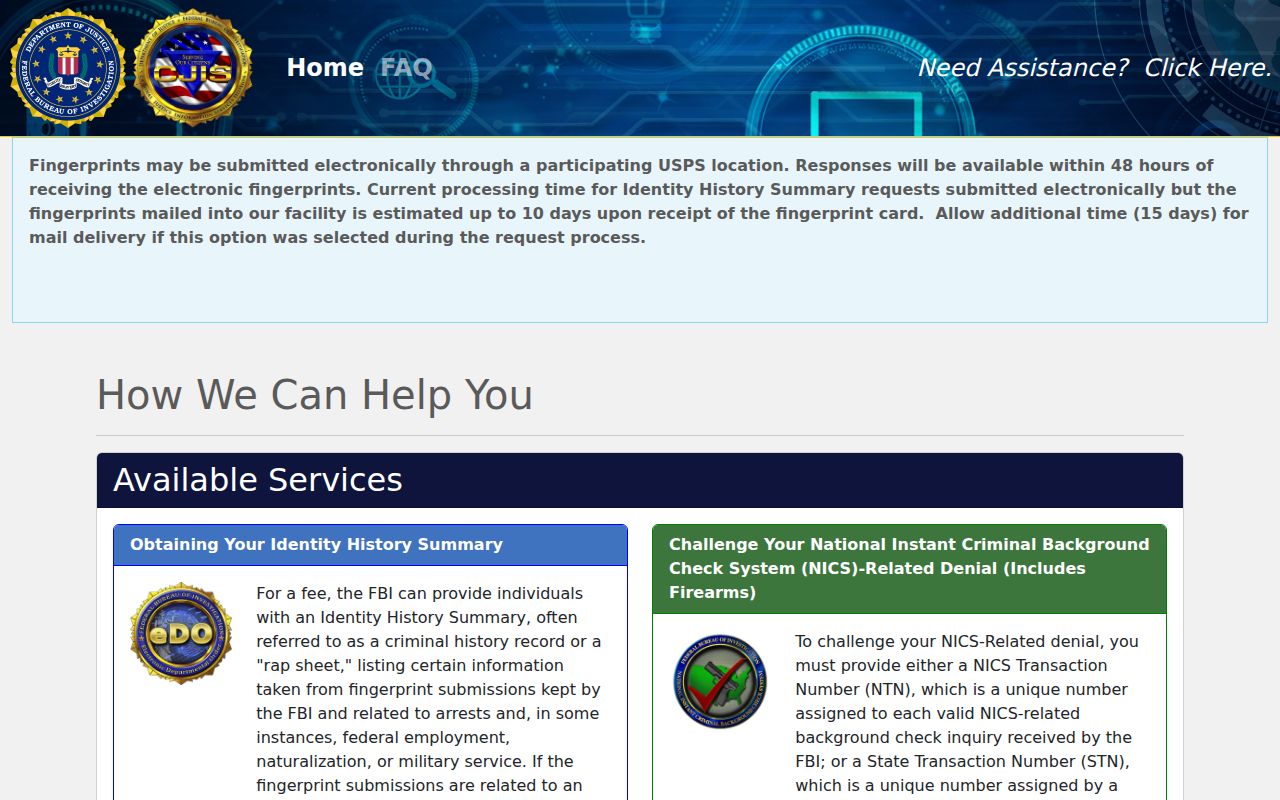
The FBI product is distinct from a certified Shelby County court disposition, and a challenge should include official records from the agency that supplied the disputed item.
Shelby County’s 785.44 square miles also make jurisdiction a practical search issue. A Sheriff, municipal police department, ALEA trooper, or University of Montevallo officer may create the first report. Confirm the exact place and agency before sending a request. That one step often prevents a false blank result.